
What 2025’s Accessibility Lawsuit Numbers Mean for Your Website in 2026
2025 closed with more than 5,000 digital accessibility lawsuits filed across federal and state court, a 20% increase over 2024, and part of a streak that has now produced over 25,000 cases since 2018. A February 2026 report puts the Seyfarth Shaw total even higher, at 8,667 ADA Title III federal filings for the year. The numbers vary by methodology, but the direction is the same. If you run a website or a digital product, 2026 is a year to take this seriously.
Where the lawsuits are concentrated
eCommerce accounts for roughly 70% of all cases. Restaurants, retail, and hospitality follow. These aren’t industries with uniquely broken websites — they’re industries where consumer interaction is high, the physical-digital connection is clear, and plaintiff firms have well-established playbooks.
Larger companies are increasingly targeted. In the first half of 2025, 36% of sued companies had annual revenue over $25 million, up from 33% the year before. Plaintiff firms are following the money. But smaller companies haven’t been spared, they still make up most defendants.
Geography matters too. New York and California dominate state-level filings, but Illinois saw a 746% surge in cases in the first half of 2025 as plaintiff firms relocated to friendlier jurisdictions. If your site is accessible anywhere, courts are increasingly willing to hear the case.
What’s broken on most websites
94.8% of the top one million homepages contain detectable WCAG failures, according to WebAIM’s 2025 analysis, and 96% of those errors fall into just six categories. These are not obscure technical gaps. They’re the kinds of issues that appear in the components teams build and reuse every day:
- Low color contrast between text and backgrounds, the single most common failure, appearing on more than 80% of sites
- Missing or inadequate alt text on images, including product photos and decorative elements
- Unlabeled form fields, meaning a screen reader user can’t complete a checkout, contact, or registration flow
- Keyboard navigation failures, interactive menus, modals, and filters that can only be operated with a mouse
- Videos without captions
- Links and buttons with no descriptive text, “click here” or an icon with no label
The other thing worth knowing: automated scanning tools only catch about 30% of WCAG issues. The rest require human evaluation against real assistive technology.
Two regulatory shifts that change the picture in 2026
The first is domestic. April 24, 2026 is the WCAG 2.1 AA compliance deadline for state and local governments serving populations over 50,000, covering cities, counties, state agencies, large school districts, and public universities. Once that deadline passes, plaintiff attorneys have clear legal grounds to sue entities that haven’t remediated. If you work with public-sector clients, the conversation to have now is about where they stand and what triage looks like.
The second is international. The European Accessibility Act became enforceable in June 2025 and applies to any business with consumer-facing websites or apps reaching EU customers — regardless of where that business is headquartered. France, Sweden, and Denmark all moved quickly after the deadline. No named US companies have faced confirmed public enforcement yet, but that is expected to change in 2026.
Both regulations converge on the same technical standard: WCAG 2.1 Level AA.
Do not rely on the Accessibility Overlay Widget
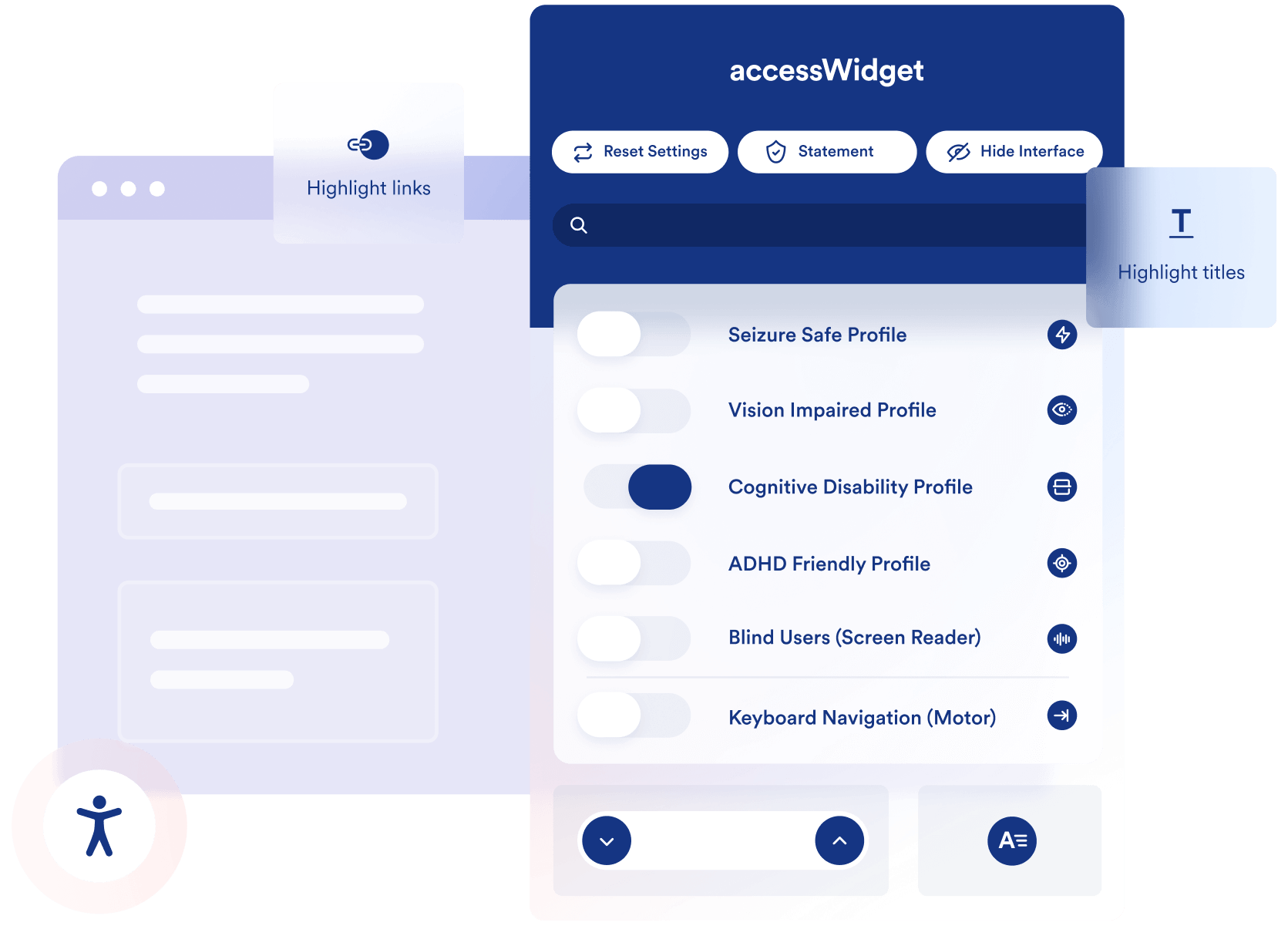
Accessibility overlay widget, the JavaScript tools marketed as one-line compliance solutions, do not hold up. Widget-related lawsuits ran every single month of 2025. The FTC acted against a major provider for misleading compliance claims. Installing a widget signals awareness of an accessibility obligation, but the site itself still needs to be review and fixed.
How Marker Seven approaches this
Accessibility isn’t something you layer on at the end of a project. It runs through design decisions, color systems, component structure, typography, through development, and through content. It also must be maintained: every site update, new integration, or CMS change is an opportunity to introduce new failures.
We build WCAG compliance into the process from the start, and for clients with existing sites, we conduct manual audits that go beyond what automated tools can surface. Whether your concern is an upcoming Title II deadline, EAA exposure from EU customers, or simply reducing litigation risk on a high-traffic eCommerce site, we can help you understand where you stand and what remediation looks like.